
What is a Ruea Phra?
The Buddha boats of southern Thailand — their legend, their parts, and where to see them in Surat Thani.
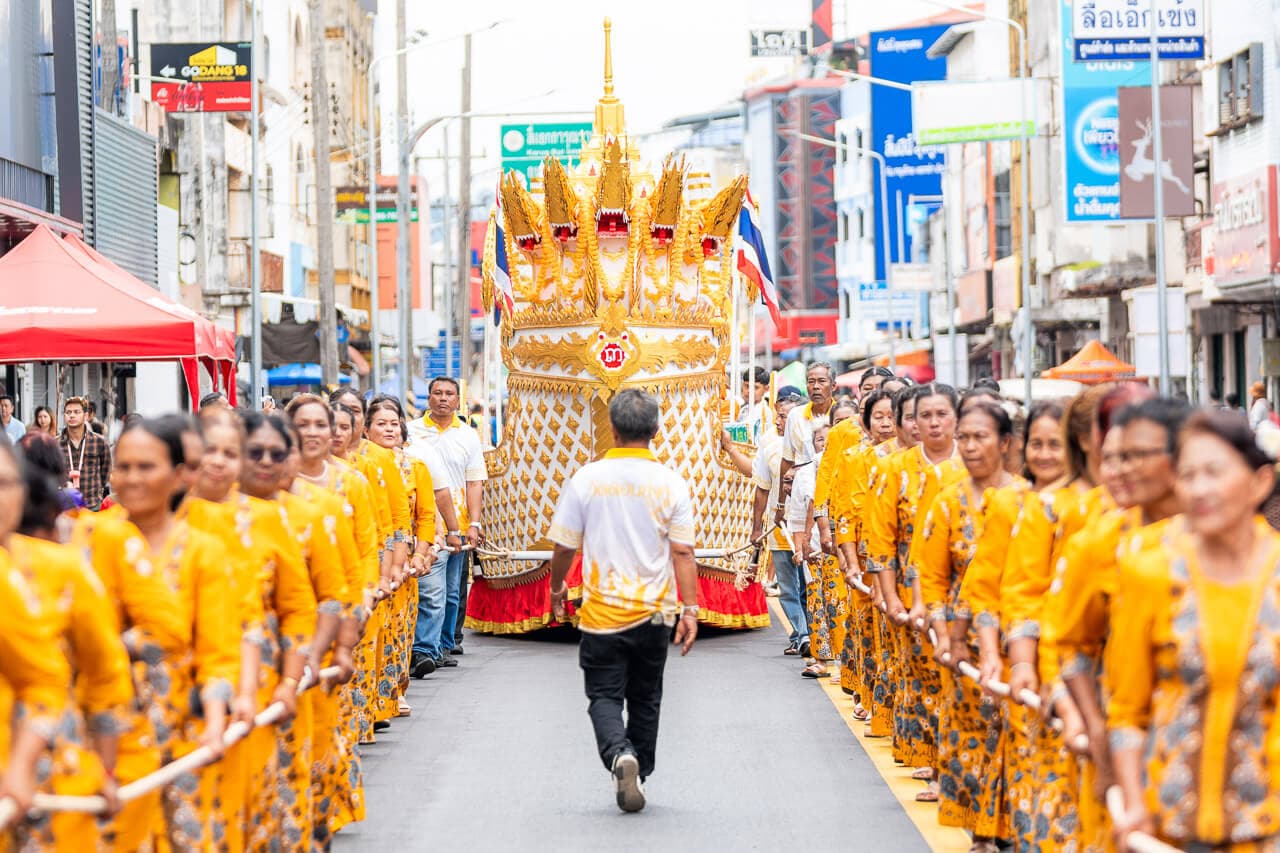
A Ruea Phra (“Buddha boat”) is a float built in the shape of a boat, with a spired throne — the Nom Phra — at its centre holding a Buddha image. Villagers pull it through the streets or along the river in the Chak Phra festival, held every year the day after the end of Buddhist Lent.
What is a Ruea Phra?
In the south of Thailand, “Ruea Phra” does not mean a boat that monks travel in. It is the vehicle that carries a Buddha image in procession on Chak Phra day. It can be a real boat on the water or a truck on the road — as long as it is shaped like a boat and has the throne in the middle.
Names vary by place. Surat Thani officially calls it a Ruea Phanom Phra and calls the tradition Chak Phra; Songkhla, Phatthalung and Nakhon Si Thammarat say Lak Phra. Both mean “pulling the Buddha”.
Each boat is a work of Buddhist art, the pride of its temple, and a project the whole village builds together once a year.
The legend behind it
The story goes that the Buddha spent one rains retreat in Tavatimsa heaven, teaching his mother. He returned to earth at the city of Sankassa at dawn on the 1st waning day of the 11th lunar month.
The townspeople seated him on a throne and carried him in procession. The crowd was so thick that people at the back wrapped their food offerings in leaves and passed — or threw — them forward. That is the origin of khanom tom, the triangular sticky-rice parcels still made for the festival today.
After the Buddha’s passing, a Buddha image took his place in the yearly procession. Scholars believe the custom came from India and reached the southern peninsula in ancient times.
Why a boat? Southern towns grew up along rivers and canals, so the procession began on water. When roads took over, the boat shape stayed.
Land boats and river boats
Land boats
Pulled along the road. Once built on two logs dragged over the ground, later on wheels, and today mostly on a pickup or truck chassis with a boat or naga bow and stern. By far the most common type.
River boats
Several real boats lashed side by side into a raft, with the throne on top, towed by villagers’ paddle boats. Found in riverside communities such as those on the Tapi River and around Songkhla Lake.
Parts of a Ruea Phra
Every temple has its own design, but the main parts are the same. Spin the 3D model to take a look.
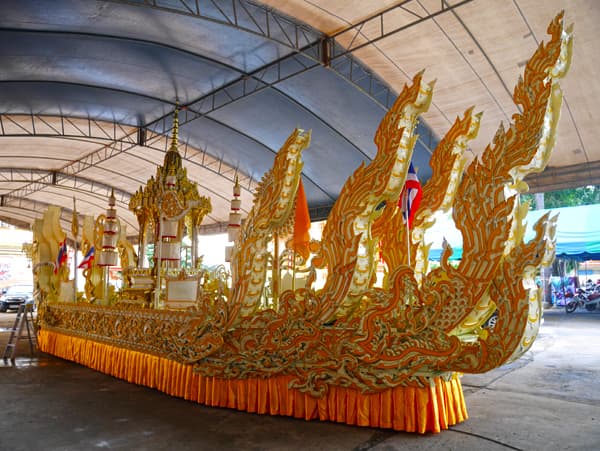
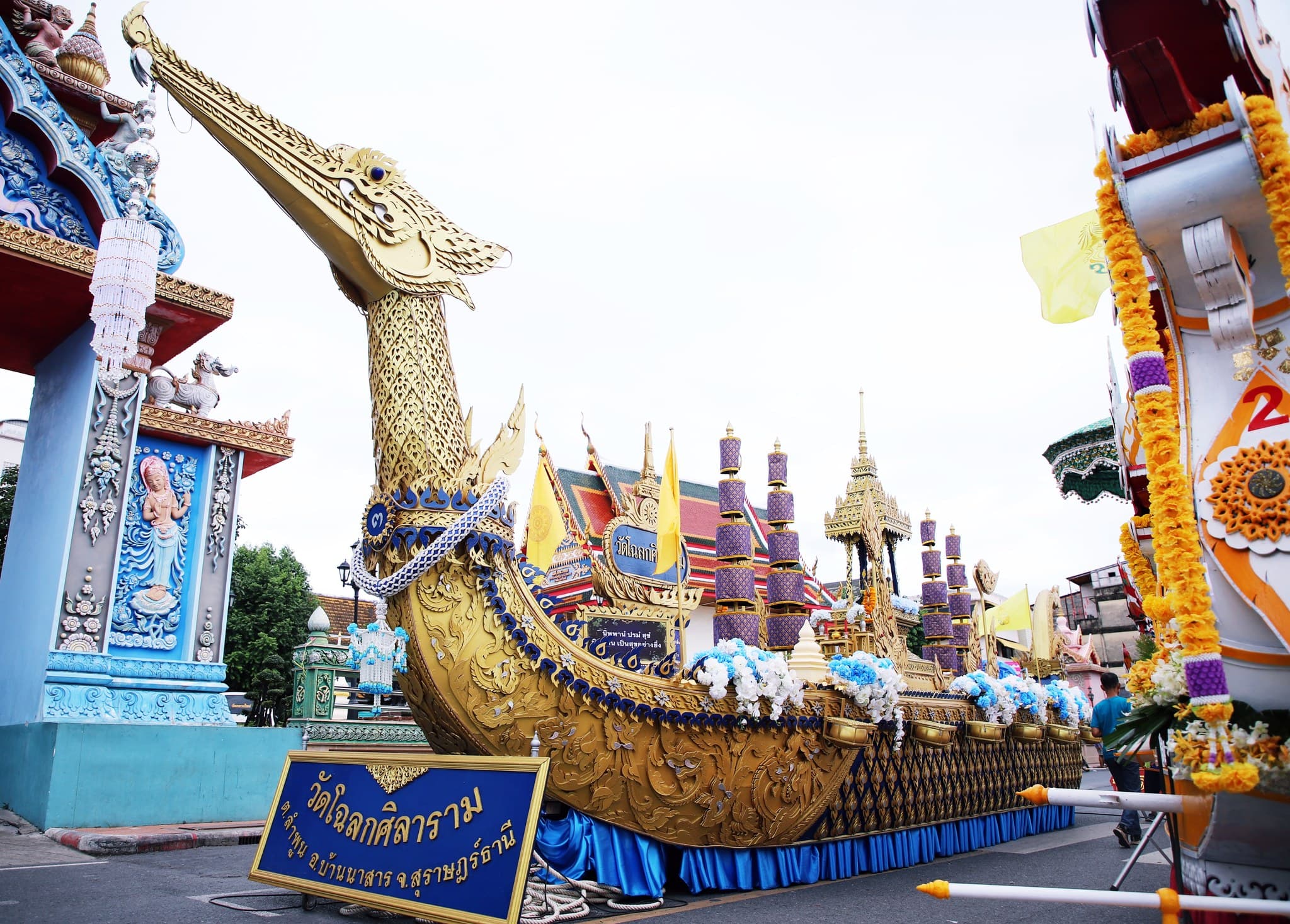
- Hull — the base. Bow and stern are usually a naga, the serpent guardian of Buddhism linked with water; some temples choose a swan, garuda or other mythical creature.
- Nom Phra (busabok throne) — the heart of the boat: a four-pillared pavilion with a tiered, spired roof and traditional Thai ornament. This is where the craftsmen put their best work.
- Buddha image — usually in the alms-bowl posture, matching the legend. Some temples bring out their most revered image once a year.
- Drums, gongs and bells — played all along the route. The deep phon drum heard from afar means a boat is coming.
- Flags and decorations — pennants, tiered umbrellas, fresh flowers, coloured cloth and strings of khanom tom hung as offerings.
- Pulling ropes — two thick ropes at the bow, by tradition one for men and one for women. Anyone may take hold and share in the merit.
How a boat is made
A boat is on show for a few days, but it takes a community months to build — some temples start at the beginning of Lent. The builders are monks, novices and villagers who pass the craft down from one generation to the next.
- Design — temples entering the contest usually create a new design every year.
- Frame — a wood or steel frame for hull and throne goes onto the vehicle.
- Carving — once wood and cut paper, now mostly carved foam, then painted, gilded and set with mirror glass.
- Decoration and lighting — today’s boats must look good by day and by night.
Ten to fifteen days before the festival, temples begin khum phra: beating the phon drum every evening to tell the village that pulling day is near and help is needed.
Pulling day
On the full-moon day that ends Buddhist Lent, the Buddha image is placed on the throne and blessed in the evening. At dawn the next day people give alms in front of the boat, and then the pulling begins.
The pullers chant call-and-response verses to keep in time — the best known goes “I-sara-pha, helo, helo”. Householders along the way come out to make merit, hang khanom tom on the boat, or join the ropes for a stretch. The boats of many temples meet at the town’s gathering ground.
The festival in Surat Thani
Surat Thani holds one of the biggest Chak Phra festivals in Thailand: the Chak Phra, Thot Pha Pa and Long-boat Racing Festival, about nine days along the Tapi River embankment in town. Dozens of boats from temples and organisations across the province park side by side for visitors to see, by day and by night.
What sets Surat Thani apart is Phum Pha Pa. On the eve of Chak Phra day, homes, shops and offices set up robe-offering displays with scenes from the Buddha’s life, lit up all over town, and people stroll among them through the night. Before dawn monks collect the robes by lot. Then come the land and river processions, and finally long-boat races on the Tapi.
For dates and the daily programme, see the Chak Phra festival 2026 schedule.
The boat contest
The boats get more beautiful every year partly because they compete. In Surat Thani the Provincial Administrative Organization runs the land-boat contest, and the winners receive royal trophies.
- Beauty — large and small classes, judged on craftsmanship and faithfulness to traditional Thai art.
- Creativity — open in materials and ideas; expect local materials and unusual forms.
- Procession — the whole parade is judged: costumes, performances and teamwork.
For the temples, the prize comes second. What matters is that the village works together again and young craftsmen learn from the old.
See the boats
We have photographed the boats of 125 temples at the Surat Thani festival. Browse by year, or walk through the festival in 360°.

FAQ
What is a Ruea Phra?
A Ruea Phra ("Buddha boat") is a boat-shaped float with a spired throne in the middle that holds a Buddha image. Villagers pull it in the Chak Phra (Lak Phra) festival of southern Thailand, held the day after the end of Buddhist Lent.
What does "Chak Phra" mean?
"Chak Phra" means "pulling the Buddha". In Songkhla, Phatthalung and Nakhon Si Thammarat the same tradition is called "Lak Phra". In Surat Thani the boats are officially called "Ruea Phanom Phra".
What is the Nom Phra?
The Nom Phra, or Phanom Phra, is the spired busabok throne at the centre of the boat where the Buddha image sits. It is the most important part and gets the finest craftsmanship.
When are the boats pulled?
On the 1st waning day of the 11th lunar month, the day after the end of Buddhist Lent — usually in October. In Surat Thani the boats stay on show along the Tapi River for several days.
Where can I see the boats in Surat Thani?
During the festival, boats from temples across the province line up along the Tapi River embankment in Surat Thani town. The rest of the year you can see them on rueaphra.com, by temple and in 360°.
Written by the Ruea Phra team from local accounts, announcements of the Surat Thani Provincial Administrative Organization and works on southern Thai culture. Spotted a mistake? Tell us on our Facebook page.
 View 360°